
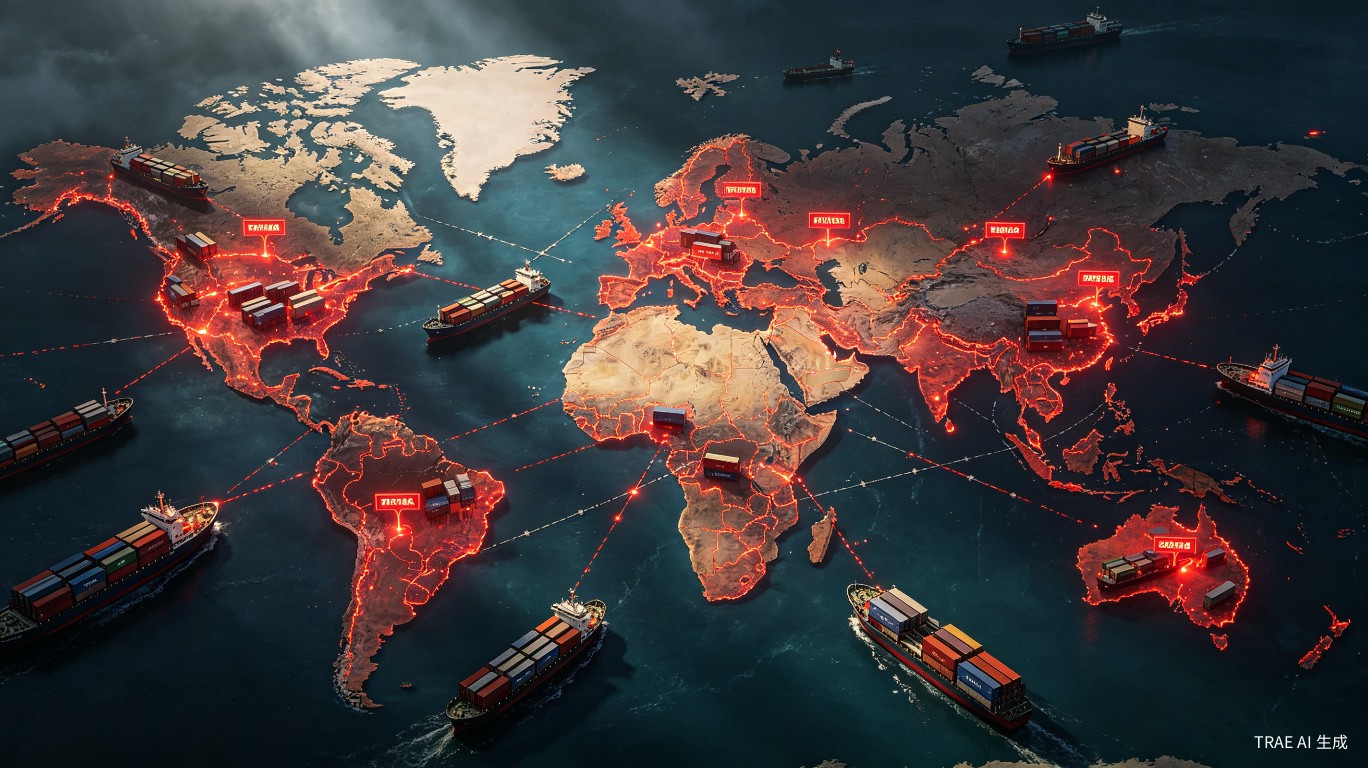
Tariff Escalation Reaches Unprecedented Levels
The landscape of global trade in mid-2026 bears little resemblance to the relatively open system that defined the post-Cold War era. Tariff rates on hundreds of billions of dollars' worth of traded goods have climbed to levels not witnessed since the Smoot-Hawley era, as the world's three largest economic blocs — the United States, the European Union, and China — engage in a protracted cycle of retaliatory trade measures.
According to the Peterson Institute for International Economics, the average effective tariff rate on US imports has reached 14.3 percent as of June 2026, the highest since 1934. The Trump administration's imposition of a blanket 25 percent tariff on all Chinese imports, announced in January and fully implemented by March, triggered cascading retaliatory actions from Beijing and subsequent countermeasures from Washington. The US also raised tariffs on European steel and aluminum from 10 to 25 percent in February, widening the conflict beyond the Pacific.
China responded within 72 hours of the January US announcement, slapping tariffs averaging 22 percent on American agricultural products, semiconductors, aircraft components, and heavy machinery. Beijing also expanded its export control regime, restricting shipments of rare earth elements, gallium, and germanium — critical inputs for US defense systems and electronics manufacturing.
The ripple effects have cascaded throughout the Asia-Pacific region and beyond. "No country is immune to the current trade disruptions," said Dr. Mari Pangestu, former Indonesian trade minister and current professor at the University of Indonesia. "What we are witnessing is not merely a trade war but a fundamental restructuring of how global production is organized — a shift that will persist regardless of which administration occupies the White House."
Supply Chain Realignment Accelerates Across Asia
Southeast Asian nations have emerged as the primary beneficiaries of the tariff-driven relocation of manufacturing capacity. Vietnam's exports to the United States surged 34 percent year-over-year in the first five months of 2026, with electronics assembly, textiles, footwear, and furniture leading the growth. Foreign direct investment into Vietnam reached $18.7 billion in Q1 2026, according to the country's Ministry of Planning and Investment, up 42 percent from the same period in 2025. Major electronics manufacturers, including LG and Foxconn, have expanded facilities in Haiphong and Bac Ninh provinces.
India has also positioned itself as an alternative manufacturing hub, with the Modi government's production-linked incentive schemes attracting major electronics and pharmaceutical companies. Apple supplier Foxconn announced in April plans to invest $5 billion in its Tamil Nadu facility, while Samsung Electronics committed $3 billion to expand smartphone production in Uttar Pradesh. Mexico, meanwhile, has benefited from nearshoring trends, with US imports from Mexico surpassing those from China for the first time in two decades during Q1 2026.
European Manufacturers Caught in the Crossfire
European industry leaders have found themselves squeezed between US tariffs on European steel, aluminum, and automobiles on one side and Chinese retaliatory measures targeting European luxury goods, machinery, and automotive components on the other. The European Commission estimates that EU exports face an average effective tariff of 12.7 percent when entering the US market — more than double the rate in 2024 and the highest since the formation of the European single market.
Germany's automotive sector, the crown jewel of European manufacturing, has been particularly hard hit. Volkswagen Group reported a 15 percent decline in US sales for Q1 2026, while BMW warned that its operating margin in North America could fall below 4 percent this year. "European automakers are being forced to choose between absorbing tariff costs and losing market share, and neither option is sustainable," said Dr. Henrik Müller, professor of international economics at TU Dortmund University. The European Union has retaliated with tariffs on $28 billion worth of US goods, including bourbon whiskey, motorcycles, and agricultural equipment.
Consumer Prices Rise as Tariff Costs Pass Through
The cost of tariff escalation is increasingly visible on retail shelves across developed economies. The National Retail Federation estimates that US consumers are paying an average of 8 to 12 percent more for imported consumer electronics, appliances, footwear, and household goods compared to January 2025. Walmart CEO Doug McMillon stated in the company's Q1 earnings call that "tariff-related cost increases are being passed through to retail prices faster than in any previous trade dispute, reflecting the breadth and depth of the current tariffs."
The impact extends beyond finished consumer goods. The Federal Reserve's Beige Book for May 2026 noted that "manufacturing input costs have risen sharply due to tariffs on intermediate goods," with 73 percent of surveyed manufacturers reporting higher materials costs. Small and medium-sized enterprises, lacking the pricing power of large corporations, have been hit disproportionately hard. Profit margins in US manufacturing contracted by an average of 3.2 percentage points in Q1 2026, according to the National Association of Manufacturers.
WTO Reform Efforts Stall Amid Growing Tensions
Attempts to reform the World Trade Organization's dispute resolution mechanism have made little headway in 2026. The WTO's Appellate Body remains paralyzed due to sustained US opposition to new judge appointments, rendering the organization's enforcement capabilities essentially toothless for most disputes. The WTO's latest ministerial conference in Abu Dhabi in February failed to produce any meaningful consensus on tariff discipline, with member nations deeply divided over the legitimacy of national security-based tariff justifications.
"The multilateral trading system is facing its most serious crisis since the WTO was established in 1995," said Ngozi Okonjo-Iweala, the WTO Director-General, during a June 10 speech in Geneva. "Without a functioning dispute resolution mechanism, the rules-based system risks being replaced by the law of the jungle."
In the absence of multilateral progress, nations have turned to bilateral and regional trade agreements. The Comprehensive and Progressive Agreement for Trans-Pacific Partnership added three new members in 2026, while the Regional Comprehensive Economic Partnership member states deepened tariff reduction commitments. China has accelerated negotiations for a trilateral China-Japan-Korea free trade agreement, viewing regional integration as a hedge against US trade pressure.
Outlook: A Fragmented Global Trading System
Economists surveyed by the International Monetary Fund in May 2026 project that global trade volume will grow by only 1.8 percent this year, down from 3.2 percent in 2025 and well below the pre-pandemic average of 4.5 percent. "We are moving toward a world of competing trade blocs rather than a single integrated global market," said Gita Gopinath, First Deputy Managing Director of the IMF.
For businesses operating in this environment, the new normal demands permanent structural flexibility. Supply chain diversification, once viewed as a discretionary risk management strategy, has become a survival imperative. The era of efficiency-above-all in global supply chains is over. Companies must now build redundancy and regional capacity into their operating models. The cost of resilience is high, but the cost of being caught unprepared is far higher.